

Spotlightr vs Other DRM Video Encryption Platforms: The Short Answer for Course Creators & B2B
If you sell online courses, run a membership site, or distribute B2B video content and trying to stop unauthorized access to your video content, Digital Rights Management (DRM) video encryption platforms are your best defense. Picking the right DRM video encryption platform determines whether your content stays protected or ends up on piracy sites. The choice comes down to six hosted platforms (Spotlightr, VdoCipher, Vimeo, Brightcove, Kaltura, Muvi) and a separate tier of multi DRM middleware providers (ExpressPlay, Verimatrix, Axinom) for teams that want to build their own stack.
These platforms lock your videos behind a digital vault and ensure that only the right people can watch. This level of protection helps you maintain control over your content, meet copyright regulations, and avoid the financial gut-punch of piracy.
This comparison breaks them apart on the factors that actually decide things for educators and B2B teams: DRM coverage and device compatibility, ease of implementation, course and marketing features, and pricing. It also helps you understand how to implement drm across hosted platforms versus middleware.
The short answer: Spotlightr is the strongest fit for small-to-mid-sized course creators and B2B marketers who need Widevine and FairPlay DRM encryption bundled with lead capture, branded players, and LMS integrations in a single SaaS subscription. Spotlightr supports Google Widevine and Apple FairPlay but does not support Microsoft PlayReady; in practice, that covers Chrome, Firefox, Edge (Chromium), Android devices, Safari, iOS devices, and macOS.
If your audience watches primarily through browsers and mobile apps, PlayReady’s absence will not affect you. Brightcove, Kaltura, or Muvi win if you are building a full OTT service with smart TVs, set-top boxes, and TV apps. Vimeo’s DRM protection is gated behind its OTT/Enterprise tiers. DIY middleware only makes sense if you already employ video engineers and operate your own encoding infrastructure.
The four decisive factors this article covers: DRM breadth and device coverage, ease of implementation and LMS integration, course and marketing features beyond DRM, and pricing with total cost of ownership.

What Is a DRM Video Encryption Platform?
A DRM video encryption platform is a hosted service that handles video encoding, content encryption (typically AES-128 or AES-256), DRM license server management for Widevine, FairPlay, and/or PlayReady, player integration, and access control. DRM digital rights management is a technology stack used by content owners to prevent unauthorized distribution. The platform encrypts your video file, stores DRM keys on a license server, and ensures only authorized users can decrypt and watch the content while helping protect creators’ intellectual property.
In the simplest of terms, think of DRM platforms as digital bouncers for your content. They decide who gets in and who gets kicked to the curb. There are two categories exist within this space.
The first is “video hosting + DRM,” where a single provider handles hosting, encryption, player, analytics, and often marketing tools. Spotlightr, VdoCipher, Vimeo, Brightcove, Kaltura, and Muvi all fall here.
The second is “multi DRM middleware only,” where providers like ExpressPlay, Verimatrix, and Axinom supply license generation, key management systems, and policy enforcement APIs, but you bring your own video hosting, encoders, packagers, and players.
For course creators and B2B teams, the distinction matters because hosted platforms reduce moving parts and DevOps overhead. Middleware gives maximum control but demands engineering resources and longer time to launch.

DRM Basics: How Widevine, FairPlay, and PlayReady Work
Understanding how different DRM technologies function helps you evaluate which platforms match your audience’s devices.
What “DRM Video Encryption” Actually Does
The workflow behind DRM video protection follows a consistent pattern across all major DRM systems:
– Video content is encoded into adaptive streaming formats: HLS (HTTP Live Streaming) for Apple devices and MPEG-DASH for most others.
– Each stream segment is encrypted with a content encryption key (CEK), transforming the video into an unplayable format without a decryption key.
– DRM keys are stored on a DRM license server. Content delivery networks (CDNs) can host the encrypted video content safely because the media data remains secure without the corresponding keys.
– When a viewer presses play, the DRM video player sends a secure license request. The license server authenticates users and returns the decryption keys only after verifying device identity and usage rights.
– A Content Decryption Module (CDM) on the viewer’s device handles decryption inside a secure sandbox, enabling seamless playback without exposing raw video data.
DRM goes beyond simple HTTPS links or basic HLS streaming encryption. DRM can enforce expiration rules concerning access to video content, limit concurrent streams, control offline playback rights, restrict playback to specific regions via IP geolocation, and prevent unauthorized downloads and screen recording. DRM helps reduce casual piracy and unauthorized access by making intercepted video segments unusable without a valid license.
Google Widevine
Google Widevine DRM is the most widely deployed DRM system across non-Apple devices. It runs in Chrome, Edge (Chromium), and Firefox on desktop; on Android devices (phones, tablets, Android TV); on Chromecast; and on many smart TVs. DRM in browsers uses the Encrypted Media Extensions (EME) API to communicate between the player and the CDM.
Widevine DRM offers three levels of security:
– L1: Maximum security with hardware-based decryption for HD and 4K content.
– L2: Mid-level security for most HD streams.
– L3: Basic software-based security that caps playback at 480p (SD).
If your course content is HD or 4K, your students need L1-capable devices to see full quality. Most modern Android phones and Chromebooks ship with L1 support; older or budget devices may only meet L3.
If your audience is heavy on Android, Chrome, or smart TVs, Widevine is non-negotiable.
Apple FairPlay
Apple FairPlay DRM protects video delivered over HLS to Safari browser on macOS, native iOS/iPadOS apps, and tvOS apps. Because Apple controls hardware, OS, and browser together, FairPlay decryption often occurs inside the Secure Enclave, making screen capture protection stronger in mobile apps and Safari than on most other platforms.
FairPlay is required for any DRM protected video content viewed on iPhones, iPads, Macs, or Apple TV. No alternative DRM works on Apple devices; if you skip FairPlay, you lose the Apple ecosystem entirely.
Implementing Apple FairPlay DRM requires obtaining certificates and keys from Apple, which can add lead time compared to Widevine. Hosted platforms handle this certificate relationship for you.
Microsoft PlayReady
Microsoft PlayReady covers Windows PCs (especially native UWP apps and legacy Edge), Xbox consoles, and a wide range of smart TVs, set-top boxes (STBs), and operator devices. Like Widevine, PlayReady uses security level tiers; SL3000 is required for premium 4K content on hardware-secured devices.
PlayReady matters most for broadcast and OTT providers distributing to living-room screens and enterprise Windows environments with locked-down configurations. For browser-based courses consumed on Chrome, Safari, or mobile apps, PlayReady adds little practical coverage because Widevine and FairPlay already handle those devices.
Spotlightr does not support PlayReady. Brightcove, Kaltura, and Muvi do. This gap becomes relevant only if your learners or viewers watch through TV apps, Xbox, or Windows-native applications that require PlayReady specifically.

DRM Coverage at a Glance: Spotlightr vs VdoCipher vs Vimeo vs Brightcove vs Kaltura vs Muvi
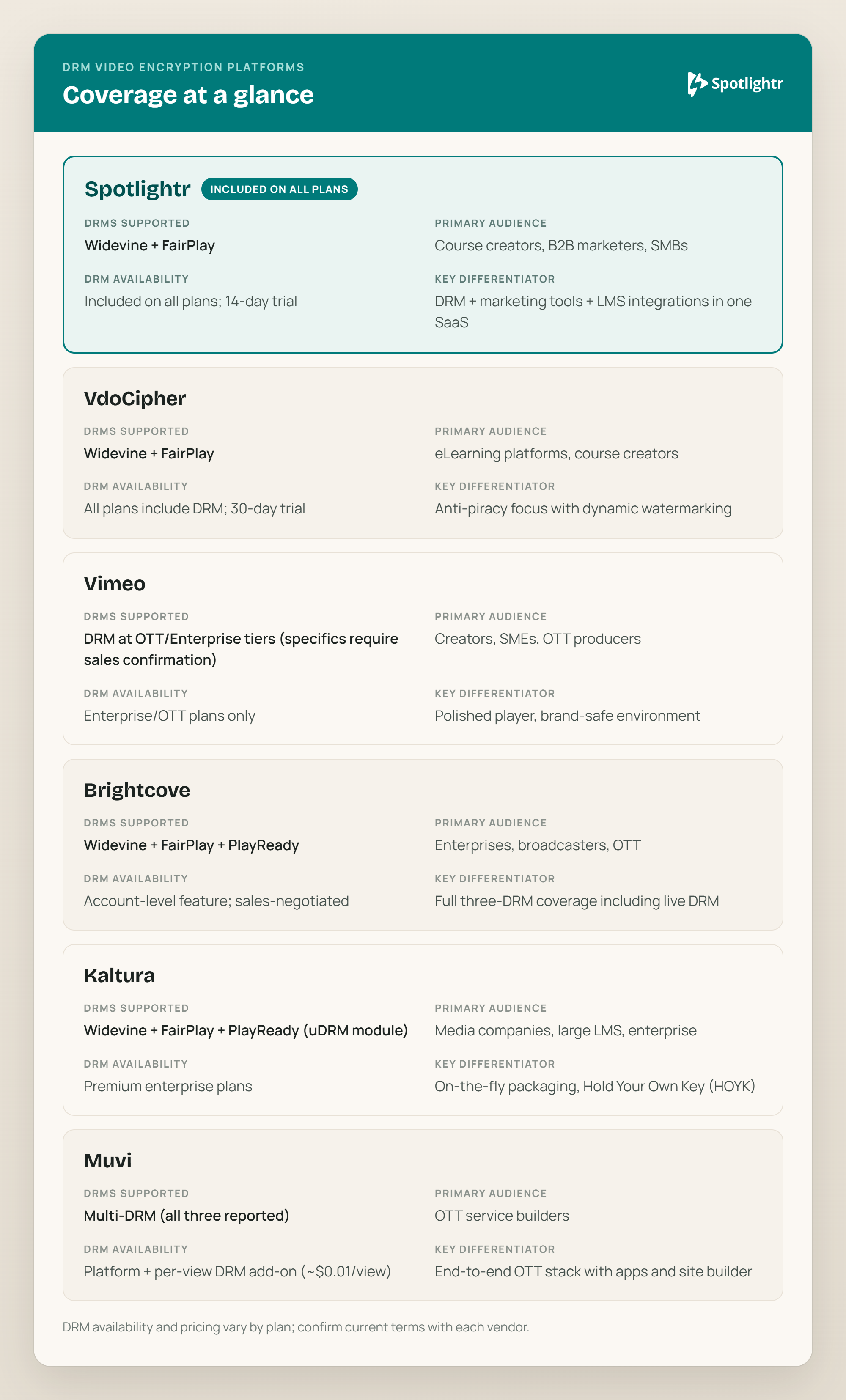
The table below shows multi DRM support, primary audience, and positioning for each platform. Multi DRM uses different technologies for various devices and browsers; no single DRM covers every screen. Spotlightr and VdoCipher focus on educators and SMBs with streamlined DRM setups. Vimeo, Brightcove, Kaltura, and Muvi skew toward enterprise video distribution or full OTT platform builds.
Decisive Factor 1: DRM Breadth, Device Coverage, and Security Levels
Device compatibility determines whether your students or viewers can actually watch your DRM protected content. Google Widevine, Apple FairPlay, and Microsoft PlayReady are common DRMs, and each covers a different slice of the device landscape.
Spotlightr
Spotlightr supports Google Widevine and Apple FairPlay, delivering encrypted video content via HLS and DASH. That covers Chrome, Edge (Chromium), Firefox, Safari, Android devices, iOS devices, macOS, and most Chromebooks. For a course creator whose students access content through browsers or mobile apps, this combination handles the vast majority of real-world devices.
The absence of PlayReady means Spotlightr cannot serve DRM protected video to devices that exclusively require PlayReady: certain smart TV platforms, Xbox, and Windows-native apps that bypass browser-based playback. For browser-first courses and LMS embeds, this gap rarely surfaces. If a measurable portion of your audience uses TVs or locked-down Windows kiosks, you would need to verify whether those devices fall back to Widevine via a browser or require PlayReady natively.
VdoCipher
VdoCipher also supports Widevine and FairPlay. Its DRM implementation emphasizes anti-piracy measures: dynamic forensic watermarking (overlaying user ID, email, IP, or timestamp on the video), blocking playback on rooted Android devices and emulators, and screen capture protection in mobile apps. VdoCipher does not list PlayReady among its supported DRM technologies.
VdoCipher’s device coverage matches Spotlightr’s for typical learner devices. Its differentiator is the depth of anti-download and anti-recording deterrents layered on top of standard DRM encryption.
Vimeo, Brightcove, Kaltura, Muvi
These four platforms support enterprise-grade multi DRM, typically covering all three major DRM systems. Brightcove’s DRM documentation confirms Widevine, FairPlay, and PlayReady for VOD (MPEG-DASH with CENC encryption for Widevine/PlayReady; HLS with FairPlay for Apple devices) and for live streams via its NextGen Live service. Kaltura’s uDRM module supports all three through on-the-fly packaging, minimizing storage by encrypting from base renditions on demand. Muvi charges approximately $0.01 per view for multi-DRM applied to streaming media.
Their PlayReady support gives them stronger coverage for smart TVs, operator STBs, and OTT apps. This matters for broadcasters and OTT services, less so for a typical LMS-based course.
Winner for DRM Coverage
For browser-and-app-based courses, Spotlightr and VdoCipher tie on device coverage. Spotlightr adds a stronger marketing and funnel stack alongside its DRM capabilities. For OTT and TV-first deployments requiring PlayReady and device certification depth, Brightcove, Kaltura, and Muvi win.

Decisive Factor 2: Ease of Implementation, LMS Integration, and Developer Effort
DRM implementation requires a license server for authentication, player configuration, and certificate management. How much of that work falls on you versus the platform varies widely.
Spotlightr
Spotlightr wraps DRM into a turn-key workflow: upload a video, the platform encodes it into adaptive streaming formats, applies Widevine and FairPlay DRM encryption, and generates an embed code so teams can integrate video DRM into an existing site, LMS, or app through Spotlightr’s hosted player and embed flow. No separate contracts with Google or Apple DRM programs are needed. No license server to operate.
Spotlightr provides native integrations with WordPress, LearnDash, and other popular course and membership platforms via embeddable players and plugins. DRM settings, domain restrictions, and access controls are toggle-based in the dashboard. A course creator can enable DRM on video hosting without writing custom player code or configuring certificate exchange flows.
VdoCipher
VdoCipher also simplifies DRM setup. Upload, encoding, DRM licensing, and player delivery are managed by VdoCipher’s infrastructure. Plugins exist for WordPress and Moodle, and REST APIs and SDKs (Android, iOS, Web, Flutter, React Native) are available for custom integration.
Where VdoCipher requires more developer involvement is in heavy UI customization. Its player is functional and security-focused, but building a branded watch-page experience with lead capture and CTA overlays involves additional tooling outside VdoCipher’s core platform.
Vimeo, Brightcove, Kaltura, Muvi
Vimeo’s OTT/Enterprise tier offers DRM enablement but typically involves higher-tier contracts and a more technical onboarding process. Brightcove and Kaltura are built for teams with in-house developers or agencies. Configuring DRM policy templates, setting up ingest profiles with content encryption, building custom players, and developing native apps for iOS, Android, and TV platforms all require engineering resources. Brightcove allows disabling clear (unencrypted) content at the account level to satisfy strict licensing, but activating that setting requires contacting their support team.
Muvi offers a guided “build your OTT service” flow with app generation and site building, which reduces some friction. It still involves more configuration than embedding a Spotlightr player into an existing LMS page.
Winner for Ease of Use
Spotlightr wins for non-technical course creators and B2B marketers who want hosted DRM plus marketing tools without coding. VdoCipher is a close second for pure course security with fewer marketing extras. Enterprise platforms justify their complexity only if you have dev resources and OTT-scale requirements.

Decisive Factor 3: Course and Marketing Features Beyond DRM
DRM solves video piracy. It does not capture leads, track engagement, or drive upsells. DRM systems are implemented across devices to secure multimedia content and playback, but course creators need more than encryption to run a business.
Spotlightr
Spotlightr bundles the following on the same platform that handles Widevine/FairPlay encryption:
– Customizable DRM video player and watch pages with full branding controls, custom colors, thumbnails, and player skins.
– Lead capture tools including email gates, in-video CTAs, and opt-in forms tied directly to video playback events.
– Per-viewer analytics with heatmaps, drop-off tracking, and user-level engagement reports showing exactly where each student stopped watching.
– Monetization support through pay-per-view gating, membership integrations, and upsell CTAs placed at specific timestamps.
– LMS compatibility with WordPress, LearnDash, Thinkific, and similar platforms via simple embed codes.
Having DRM protection and marketing automation in one subscription eliminates the need to stitch together separate video hosting, encryption, analytics, and funnel tools.
VdoCipher
VdoCipher’s core strength is its security posture. Dynamic forensic watermarking, screen recording protection in supported environments, root/emulator blocking on Android, and geo/domain restrictions are all included. Analytics and player customization are available but tuned primarily for eLearning use: tracking completions, viewing progress, and bandwidth usage. VdoCipher does not position itself as a video marketing platform; lead capture, CTA overlays, and funnel-building require separate tools. Customizable video players can be integrated into platforms to enhance viewer experience, but VdoCipher’s customization options are more limited than Spotlightr’s branded player builder.
Vimeo, Brightcove, Kaltura, Muvi
Vimeo provides a polished player, a brand-safe viewing environment, decent analytics, and live streaming. DRM is available only at higher tiers. Brightcove and Kaltura offer advanced audience segmentation, marketing automation platform (MAP) and CRM integrations, live event support, and OTT app development. Integrated analytics in these DRM platforms provide insights into usage patterns and compliance. Muvi operates as an end-to-end OTT platform with site-building, native app generation, subscription management, and pay-per-view built in. DRM can help secure monetization models like pay-per-view and subscription services, and Muvi integrates DRM directly into that flow.
These platforms can exceed the needs and budgets of individual course creators. They serve media companies and broadcasters distributing online video content across multiple channels.
Winner for Course Creators and B2B Marketers
Spotlightr wins the “DRM + marketing + LMS-friendly” category for educators and B2B teams in a single SaaS. VdoCipher wins the narrow “security-first, minimal-frills” eLearning use case. Brightcove, Kaltura, and Muvi are best when you are building full OTT products, not courses or funnels.

Decisive Factor 4: Pricing, Scalability, and Total Cost of Ownership
Many DRM platforms hide pricing behind sales calls. Here is what is publicly known, plus guidance on real cost drivers like DRM license requests, bandwidth, and feature bundling.
Spotlightr
Spotlightr uses a subscription-based SaaS model with tiered plans ranging from solo creators to SMBs. Widevine and FairPlay DRM video protection is included at specified tiers without enterprise-only gating. The platform offers a 14-day risk-free trial to test encryption, player customization, and LMS integration before committing.
The billing model is predictable: video hosting, DRM, marketing tools, and analytics are bundled into one subscription. You are not paying separate line items for license generation, CDN bandwidth, and marketing automation on top of a base video hosting fee.
VdoCipher
VdoCipher structures pricing around bandwidth, storage, and DRM-protected playback volume. Entry-level plans are affordable for solo educators. A 30-day free trial includes bandwidth and storage to test DRM features. As you scale, costs rise with traffic tiers.
The catch: VdoCipher covers video DRM and hosting, but you may need to license separate tools for lead capture, email marketing, and funnel building. Those added subscriptions increase total stack cost relative to an all-in-one platform like Spotlightr.
Vimeo, Brightcove, Kaltura, Muvi
Vimeo gates DRM behind OTT/Enterprise tiers, which require sales-negotiated pricing and carry higher minimums than course-creator-centric tools. Brightcove and Kaltura operate on enterprise contracts with minimum annual commitments; DRM, apps, and integrations are priced as modules. Kaltura’s uDRM and advanced features sit within premium enterprise tiers. Public pricing is not published for either.
Muvi takes a different approach: platform subscription plus variable fees. DRM costs approximately $0.01 per view when multi-DRM is applied. Storage runs $0.09/GB at the 1 TB tier, dropping to $0.08/GB at 10 TB. For a course library generating 100,000 DRM-protected views per month, DRM fees alone would run around $1,000/month before storage and bandwidth charges.
Winner for Cost-Effective DRM Hosting
Spotlightr and VdoCipher win for small-to-mid-sized education and B2B use. Spotlightr delivers more tools per dollar when you factor in marketing and analytics alongside DRM protection. Enterprise players (Brightcove, Kaltura, Muvi) make financial sense only at OTT or broadcast scale where PlayReady support, TV app distribution, and operator-grade features justify the cost.

DIY Multi-DRM Middleware: ExpressPlay, Verimatrix, Axinom vs Hosted Platforms
If hosted platforms are the “move-in ready” option, multi-DRM middleware is the equivalent of buying land and hiring an architect.
What Multi-DRM Middleware Does
Providers like ExpressPlay, Verimatrix, and Axinom supply cloud-based DRM license server infrastructure. They issue Widevine, FairPlay, and PlayReady licenses; manage encryption key storage and rotation; enforce DRM playback policies (rental windows, concurrent device limits, regional restrictions); and provide APIs and SDKs for integrating video DRM into your own encoders, packagers, and players.
What they do not provide: video hosting, transcoding pipelines, CDN delivery, marketing tools, LMS plugins, or a ready-made DRM video player. You assemble and maintain the entire stack yourself.
When DIY Multi-DRM Makes Sense
Three scenarios justify the middleware route:
> Large OTT services needing custom workflows, multi-CDN routing, or complex rights windows across hundreds of titles and territories.
> Broadcasters integrating DRM into existing on-premise encoders and origin servers where the infrastructure already exists.
> Teams with dedicated video engineers and DevOps who want infrastructure-level control over every component, from packager to player to monitoring.
Taking this path means you accept responsibility for integrating packagers with license services, maintaining custom players across web, iOS, Android, and TV apps, handling incident response when OS vendors update their CDM implementations, and managing Apple’s FairPlay certificate provisioning process directly.
Why Most Course Creators Should Choose a Hosted DRM Platform Instead
For educators, training teams, and SMBs, DIY middleware costs more in engineering time than licensing an all-in-one platform. A single video engineer’s salary exceeds the annual subscription cost of any hosted DRM video encryption platform listed here. Launch timelines stretch from days (hosted) to months (DIY). And middleware ships without LMS integrations, lead capture, or marketing analytics.
Spotlightr wraps Widevine and FairPlay DRM, secure hosting, a customizable player, LMS integration, and marketing features into one subscription. For course creators who want to protect video content and start selling quickly, that eliminates the need to assemble and maintain a multi-vendor stack.

Which DRM Video Encryption Platform Should You Choose?
The right DRM provider depends on your audience’s devices, your distribution channels (LMS embed vs OTT apps), your technical resources, and your budget. DRM protects revenue by preventing unauthorized access to content, but the platform you choose also shapes how fast you can launch and how well you can market.
Choose Spotlightr if:
> You are a course creator, educator, or B2B marketing team needing Widevine and FairPlay DRM plus lead capture, branded player, and detailed video analytics.
> You use WordPress, LearnDash, Thinkific, or similar LMS/membership tools and want embed codes that work without developer involvement.
> You want to avoid managing separate DRM software, hosting, and marketing products.
Choose VdoCipher if:
> Preventing video piracy is your primary concern and you are willing to use other tools for funnels and marketing.
> You are an eLearning business with predictable learner device types and need features like dynamic forensic watermarking.
Choose Vimeo, Brightcove, Kaltura, or Muvi if:
> You are launching a full OTT or broadcast-style service with apps on smart TVs and set-top boxes.
> You have an in-house tech team or agency to integrate APIs and build apps across multiple DRM systems.
> PlayReady support for Windows-native, Xbox, or TV-operator environments is a hard requirement.
Choose ExpressPlay, Verimatrix, or Axinom (DIY middleware) if:
> You already operate your own encoding and origin infrastructure and need only license services.
> You employ engineers familiar with multi-DRM workflows and building players across web, mobile, and TV platforms.
For the majority of online educators and B2B video teams, a hosted DRM video encryption platform delivers the best balance of security, speed to launch, and ongoing simplicity. Spotlightr covers that ground with Widevine and FairPlay DRM, marketing tools, and LMS integrations in a single subscription.
Frequently Asked Questions About DRM Video Encryption Platforms
Do I really need multi-DRM (Widevine + FairPlay + PlayReady) for my courses?
Widevine + FairPlay cover nearly all learner devices: Chrome, Firefox, Edge (Chromium), Android phones and tablets, Safari, iPhones, iPads, and Macs. PlayReady adds coverage for certain smart TVs, Xbox, and Windows-native apps. Most course creators whose students watch through browsers or mobile apps can operate with Widevine and FairPlay alone. PlayReady becomes critical only if you distribute to TV apps or locked-down Windows kiosks that do not support Widevine through a browser.
Will DRM video encryption hurt playback performance or video quality?
Modern DRM implementations, including Spotlightr’s, use adaptive streaming formats (HLS/DASH) with hardware-assisted decryption via the device’s Content Decryption Module. On supported devices, there is no noticeable latency or quality loss. Older or very low-end devices that only support Widevine L3 may be limited to standard definition playback rather than HD. DRM playback quality depends on the security level of the viewer’s device, not on the encryption itself.
Can DRM stop screen recording entirely?
DRM can prevent screen recording of protected content on many devices. On iOS and in Safari, FairPlay blocks built-in screen recorders. On Android, Widevine L1 with properly configured players can black out screen capture apps. No DRM can prevent someone from pointing an external camera at a screen. DRM limits unauthorized copying and protects brand image by making mass redistribution impractical, but it does not eliminate every possible capture method. Forensic watermarking (offered by VdoCipher and some enterprise platforms) adds a tracing layer that deters leaks by identifying the source account.
How hard is it to migrate to Spotlightr from another DRM platform?
Migration follows three steps: export your existing video files, upload them to Spotlightr for re-encoding and DRM packaging, then replace embed codes in your LMS or website with Spotlightr embeds. Access rules can be mapped into Spotlightr’s access controls or connected via API and Zapier integrations. Most small-to-mid-sized course libraries can be migrated incrementally, starting with best-selling or most sensitive digital content.
Is DRM compliant with education privacy regulations (FERPA, GDPR)?
DRM itself governs content access and encryption, not student data usage. DRM ensures compliance with licensing and copyright laws by controlling who can view and redistribute content. Privacy compliance (FERPA, GDPR) depends on how the platform handles user data, analytics, and storage. When evaluating any DRM provider, verify their data processing agreements, server locations, and data retention policies separately from their DRM capabilities.
What happens if a browser or OS changes its DRM implementation?
With hosted platforms like Spotlightr, Vimeo, or Brightcove, the vendor tracks DRM changes from Google, Apple, and Microsoft and updates players and license workflows. Customers do not need to rebuild anything. With DIY middleware setups, your engineering team must monitor CDM updates, test across affected devices, and patch players and integrations. Browser and OS vendors update their DRM implementations periodically; hosted platforms absorb that maintenance cost as part of the subscription.
Spotlightr Video Hosting - DRM On All Plans
DRM, devices limits, dynamic watermarks and OTP delivery on every plan.
Test our protection and register for a free 2 week trial, no credit card required.

Bill is the founder of Spotlightr, a video platform used by course creators, membership sites and marketers who need their video hosted properly rather than uploaded somewhere and hoped for. He writes about instructional video from the inside — what creators actually publish, where students actually stop watching, and what the platforms in this category actually charge. He’s currently building Spotlightr Courses, a course product built around the video rather than bolted on top of it.